by Shelt Garner
@sheltgarner
I just realized recently that ChatGPT can generate Thomas Nast-like political cartoons. As such, I’ve become low-key addicted to thinking up different political cartoons.


Be The Power
by Shelt Garner
@sheltgarner
I just realized recently that ChatGPT can generate Thomas Nast-like political cartoons. As such, I’ve become low-key addicted to thinking up different political cartoons.
Author: The Gawker Team
Date: April 2, 2025
Tired of the endless scroll, the shouting matches, the feeling that online conversations rarely build towards something meaningful? Here in Tightsqueeze, Virginia, looking out at the digital landscape of April 2025, we’ve been conceptualizing Gawker – not just as an alternative, but as a fundamental rethink of how online communities could function, designed for depth, collaboration, and quality from the ground up.
The Gawker Difference: Built on Pillars of Quality & Collaboration
Gawker is envisioned around several core ideas working together:
Connecting, Bridging, Sustaining: The Wider Ecosystem
Beyond the core interaction, Gawker’s concept includes features to make it more powerful and connected:
The Vision: A Smarter Social Web
Imagine these elements working in concert: curated participation ensuring quality, focused groups providing relevance, deeply collaborative posts enabling creation, powerful integration with external content, and smart tools keeping you connected efficiently. This is the Gawker vision – an online environment built not just for fleeting reactions, but for sustained collaboration, knowledge building, and genuinely thoughtful interaction. We believe that by designing for quality first, perhaps starting with a curated, invite-only launch, a truly different kind of online community can emerge.
Gawker is more than just features; it’s a concept aimed at elevating online discourse. It’s about building a space where collaboration thrives and quality conversation is the norm. Imagine the possibilities.
Author: The Gawker Team
Date: April 2, 2025
We all feel it, don’t we? The endless scroll through algorithmically-charged feeds, the comment sections devolving into shouting matches, the feeling that meaningful connection and deep conversation online are getting harder and harder to find. Here in Tightsqueeze, Virginia, we’ve been thinking – maybe the problem isn’t us, maybe it’s the platforms.
What if we built something different? Something designed not just for fleeting engagement, but for durable knowledge and real collaboration?
Introducing the concept of Gawker.
What is Gawker?
Imagine blending the focused, community-driven spirit of early Usenet newsgroups with the powerful collaborative potential of modern tools like Google Docs. That’s the core of Gawker. It’s a social network built on a few key principles aimed at fostering a higher quality of interaction:
Why This Approach? Quality Over Clutter.
Gawker’s structure is designed to cultivate a healthier online ecosystem. By starting users in familiar “Family and Friends” groups, we encourage learning the ropes in a lower-stakes environment. By allowing Public Groups to potentially have vast audiences but limited, curated contributors (those who’ve passed the initial phase), we aim to elevate the quality of public discourse. Imagine popular discussions filled with contributions from people invested in the community, not drive-by trolls.
The Vision: A Space to Build Together
We envision Gawker as the platform where enthusiasts collaboratively build the ultimate guide to their hobby, where professionals refine industry best practices in an open document, where communities co-author their own stories and knowledge bases. It’s a move away from ephemeral content towards building lasting value, together.
Getting Started
We believe there’s a hunger for a different kind of online space. To ensure Gawker launches with the quality and thoughtfulness it deserves, we envision a curated, invite-only start, bringing in key voices and community builders to lay the foundation and generate the kind of content worth “gawking” at. We’re confident that when people experience a platform built for depth, the network effect of a truly “better mousetrap” will follow.
It’s time for a social network that respects conversation and empowers collaboration. It’s time for Gawker.
Are you ready for something different?
by Shelt Garner
@sheltgarner
I have to stop living in denial about this — my passion project thriller is probably too spicy for its own good. And I’m not getting any younger, so I really need to think seriously about how I spend my creative time.

I say that, then throw myself back into the very spicy novel that I keep telling myself I need to put aside so I can focus on something more marketable. I have a number of really good scifi novels I can work on. One in particular remains at the forefront of my mind all the time
And, yet, I really like the thriller. I know, just know, that if I keep at it I can produce something good enough that it will sell. There is the basic problem of how good — or bad — my writing may be, but I can only use AI to fix that particular situation so much.
So, I guess I will continue to work on the spicy thriller, damn the consequences. I keep toying with the other, scifi novels, in my mind, but nothing has really resonated to the point that I want to work on them like I continue to work on the spicey thriller.
by Shelt Garner
@sheltgarner
While I continue to get my news passively from Twitter, I’ve really cut back watching late night TV for infotainment. I just can’t handle it anymore. Nothing is going to happen and we’re careening into autocracy with a lulz.
So, I’m just going to try to focus on my novel(s) and go from there.
I also continue enjoy screwing around with AI. That’s a lot of fun. Sometimes so pretty interesting things happen out of the blue with AI, enough to keep me interested.
by Shelt Garner
@sheltgarner
While “vibe coding” is kind of silly now — it can’t really be done by just anyone for mission critical applications — a time will come, it seems, when everyone will have an Apple Knowledge Navigator-like AI agent that can code for them. So, in essence, coding will become a blackbox.

This is especially the case when we reach AGI and that AGI can recursively reprogram itself to get better.
It definitely seems as though we’re one recession away from many, many coders — most of them jr — be spun off and out of the economy altogether. Our evil corporate overlords will just pay one person to do the job of 10 — or maybe 100 — people.
What might have been a mild recession will turn into a severe one pretty quick if that type of stuff happens. It doesn’t have to be perfect, it just needs to be “good enough.”
And there doesn’t seem to be any way to stop it. It’s inevitable. Things may get so bad that laws — eventually — will be passed creating carve-outs for humans when it comes to certain jobs. But I have my doubts, given we’re apparently governed my cocksuckers now and forever.
by Shelt Garner
@sheltgarner
Sometimes, I think all the online AI community knows how to do is complain. That’s all I see on Twitter whenever something really cool is released — complain, complain, complain. Or, put another way, there’s a rush of good vibes because of the shock that something is cool, then after that shock wears off all people want to do is complain that there’s no API, or the rate limit is too low, or they can’t generate porn.

The list goes on.
I know why this is happens — most of the people complaining on Twitter are, like, 12 and don’t know better. They’ve been trained to assume they can get a rush off of the newest release and if it doesn’t give them AGI or ASI then it’s a huge disappointment, and, by the way, why can’t they generate Nazi-themed celebrity porn?
We really have to prepare ourselves for a massive wave of some pretty fucked up AI generated celebrity porn very, very soon. It will be some seriously kinky shit the moment people have the ability to generate it. Where that ability will come from — probably something open source from the Deep Web — I’m not exactly sure.
Whenever the flood gates open, the AI celebrity porn is going to be jaw-dropping in its variety of scope. There is a huge, HUGE fucking demand for AI generated celebrity porn and no fetish, no niche will go untapped once someone figures out how to create an “unaligned” open source image generator that will spit it out.
And we’re totally unprepared. People aren’t even thinking about it. And judging how aghast people were with the silly cookie monster-Taylor Swift porn that happened a little while ago, people just aren’t mentally prepared for how nasty and icky things are going to get before it’s all over with.
Sigh.
by Shelt Garner
@sheltgarner
I have just enough advertising experience — with is actually very little — to know that a tipping point is going to arrive soon when ad execs might be put in charge of some larger-than-expected ad campaigns because of AI. All we need is a recession.

And I think the moment that recession hits a certain point of contraction, instead of hiring an outside firm to do this or that print campaign, our evil corporate overlords will simply get their own ad execs to use ChatGPT (or whatever) to do it instead.
In fact, I suspect the bleeding edge of professional development for things like newspapers will be to simply train anyone with a brain and some knowledge of advertising to use ChatGPT to shoot out a pretty slick ad campaign.
And as the recession grows more severe, more and more disruption will happen to the advertising industry to the point that whatever comes out the other side won’t be recognizable.
I think coding will go through a similar transformation if there’s a severe recession, but the disruption make take longer to actually kick in because “vibe coding” will only get you so far with mission critical software –at least for now.
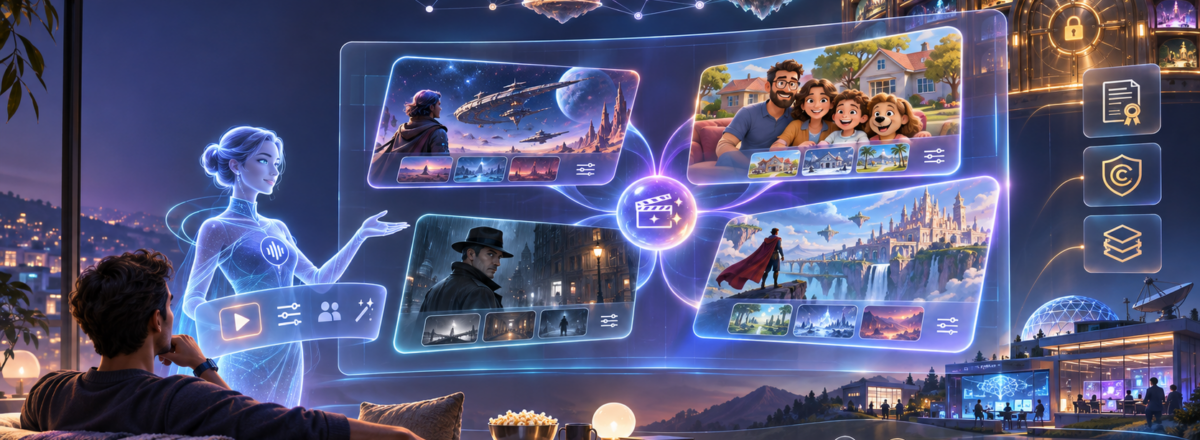
Imagine this: You settle onto your couch after a long day. Your personal AI assistant, your “Navi,” subtly scans your expression, maybe checks your biometrics, and instantly grasps your mood. Forget scrolling through endless streaming options. Within moments, it conjures a brand new, 90-minute movie – perfectly tailored to your current emotional state, blending your favorite genres, perhaps even featuring uncanny digital versions of beloved actors (or even yourself).
This isn’t just science fiction anymore; it’s the direction hyper-personalized AI is heading. And if this capability becomes mainstream, it doesn’t just change how we watch movies – it could fundamentally dismantle the very foundations of Hollywood and redefine the future for performers.
The Dream Factory Goes Digital
For over a century, Hollywood has been the global engine of mass entertainment, a sprawling industry built on creating content for broad audiences. But what happens when entertainment becomes radically individualized?
If your Navi can generate the perfect film for you, on demand, the economic model supporting massive studios, blockbuster budgets, and wide releases starts to look fragile. Why invest hundreds of millions in a single film hoping it resonates with millions, when AI can create infinite variations tailored to audiences of one?
Hollywood likely wouldn’t vanish entirely, but it would inevitably transform. It might shift from being a production hub to an IP and technology hub. Studios could become curators of vast character universes and narrative frameworks, licensing them out for AI generation. The most sought-after creatives might not be directors in the traditional sense, but “Prompt Architects” or “AI Experience Designers” – experts at guiding the algorithms to produce compelling results. The iconic backlots and sound stages could fall quiet, replaced by server farms humming with digital creation.
Where Do the Actors Go When the Cameras Stop Rolling?
This shift poses an existential question for actors. If AI can generate photorealistic performances, resurrect dead stars digitally, or create entirely new virtual idols, the demand for human actors in front of a camera (or motion-capture rig) could plummet. Competing with a digital ghost or an infinitely customizable avatar is a daunting prospect.
Enter Stage Left: The Renaissance of Live Performance
But here’s the fascinating counter-narrative: As digital entertainment becomes more personalized, synthesized, and potentially isolating, the value of live, shared, human experience could skyrocket. And that’s where Broadway, and live performance venues everywhere, come in.
AI can replicate image and sound, but it can’t replicate presence. It can’t duplicate the electric feeling of a shared gasp in a darkened theater, the visceral connection with a performer bearing their soul just feet away, the unique energy of this specific night’s performance that will never happen in exactly the same way again.
In a world saturated with perfect, personalized digital content, the raw, imperfect, tangible reality of live theater, concerts, stand-up comedy, and dance becomes infinitely more precious. It’s the antidote to the algorithm.
Could we see a great migration of performers? Will aspiring actors, finding the gates of digital Hollywood guarded by AI, increasingly set their sights on New York, London, and other centers of live performance? It seems plausible. The skills honed on the stage – presence, voice, vulnerability, the ability to command a room and connect with a live audience – become the unique differentiators, the truly human element that AI cannot synthesize.
The Future: Personalized Screens, Communal Stages
We might be heading towards a future defined by this duality: our individual worlds filled with bespoke digital entertainment crafted by our Navis, existing alongside thriving, cherished spaces dedicated to the communal, unpredictable magic of live human performance. One offers perfect personalization; the other offers profound connection.
Perhaps the flickering glow of the silver screen gives way, not to darkness, but to the bright lights of the stage, reminding us that even as technology reshapes our world, the fundamental human need to gather and share stories, live and in person, remains essential.
by Shelt Garner
@sheltgarner
It definitely seems as though we’re headed into a recession for various reasons — some of them really dumb. At the same time, a number of developments in AI suggest that any recession we have will be significantly more severe than it might be otherwise.

The software industry and the advertising industry look like they are going to be severely disrupted this year and that disruption will grow staggering if we dip into any sort of recession. AI is now officially “just good enough” to do a lot of jobs that once were really well paying.
If we have a recession, I could see a lot of established advertising firms go under simply because instead of being paid to design ads, companies will expect advertising executives to use ChatGPT to create campaigns. That sounds pretty crazy right now, but when you’re in a recession, some crazy shit can happen when people are looking to save as much money as possible.
And if the advertising industry implodes, there will be a ripple effect across the economy.
The software industry may be disrupted, but I doubt it will actually implode like what might happen to advertising. Vibe coding is fun and all, but you still need an adult to make sure bad shit doesn’t happen. With the advertising stuff, meanwhile, the end result is so great — and self-evident — that, lulz, there’s no need for many, many jobs that otherwise once existed.
But only time will tell, I suppose.
You must be logged in to post a comment.