‘The Spark’

by Shelt Garner
@sheltgarner

At the moment, there is a lot — a LOT — of slack in our political system. Most people are too busy enjoying the last, final days of summer to care about politics. But I fear that at some point in the next few years all that will change in a rather dramatic and possibly tragic fashion.

One scenario — but not the only one — is sometime around the 2026 midterms someone throws a Molotov Cocktail at a cop at just the wrong place and time and the whole country explodes into chaos. Or, specifically, Blue Cities do. And that’s when the fucking cocksuckers of the MAGA Trump regime and ICE will pounce.

They will throw everything they have at Blue Cities — ICE, National Guard troops from Red States — all with the intent of making sure that the 2026 midterms are not free and fair.

And, really, all that doesn’t have to happen for all elections from here on out — at least in my life time — not to be free and fair. The devotion to Trump on the part of MAGA is so absolute for macro reasons that, lulz, we’re going to be a political clone of autocratic Hungary before too long.

Of course, there is the very, very small possibility that Blue states and cities will finally have had enough and some sort of civil war or revolution will break out. I have my doubts that that will ever happen, but it is, if nothing else, at least *possible*.

I don’t want that to happen, but it’s something to mull going forward.

Zooming Through The First Draft Outline

by Shelt Garner
@sheltgarner

The dynamic of this first draft is a lot different than what will happen with the second draft. This is just my “vomit” draft, so I am rather slapshod at points about it all.

But when I finish this draft and sit down to write the second draft, the dynamic will be totally different. I hope — hope — to have a lot better understanding of the characters as well as the universe that it all takes place in.

I have to say that now that I have the general sense that we’ve reached an LLM “wall” that it’s a lot easier for me to map out the near future. If I still felt the Singularity was happening in a few years, then, well, uh, yikes.

But, as it stands, I think I some breathing room. At least, I hope. That’s the tough thing about writing the “near future” these days. Things are moving so fast that if you don’t stick the landing, you risk seeming rather “quaint” in your predictions.

And, yet, I really want this to be like The Eternal Sunshine of the Spotless Mind in its approach to technology. So, I think that gives me some wiggle room. But this is a novel, not a screenplay, so, lulz?

A Vibe Shift Is Upon Us

Something feels different lately. It’s hard to pinpoint exactly what it is—like trying to describe the moment when seasons change, when you suddenly notice the light hits differently or the air carries a new quality. But across conversations, social media, and everyday interactions, there’s a palpable sense that we’re witnessing what many have long predicted: the great “vibe shift” is finally happening.

The Mood is Changing

The atmosphere of the country—and perhaps the world—seems to be undergoing a subtle but significant transformation. It’s not just politics or economics, though those certainly play their part. It’s something more fundamental: a shift in collective energy, priorities, and outlook that’s been building beneath the surface and is now starting to break through.

This isn’t the first time we’ve experienced such cultural inflection points. The late 1960s brought a seismic shift from the buttoned-up 1950s. The early 1990s marked a departure from the excess of the 1980s. The mid-2010s saw the rise of a particular brand of optimistic tech culture that now feels distinctly dated. Each era carries its own fingerprint—its own way of speaking, thinking, and being.

Language as the Canary in the Cultural Coal Mine

One of the most telling indicators of this shift is how language is evolving. New phrases are entering mainstream conversation at a rapid pace, and they’re not just passing fads. Terms like “locked in”—meaning completely focused and committed to a goal—have moved from niche communities into everyday speech with surprising speed.

This linguistic evolution isn’t random. The words we adopt reflect our changing values and mindset. “Locked in” suggests a culture increasingly focused on intentionality, discipline, and results. It’s markedly different from the more passive or ironic language that dominated earlier in the decade. Where we once might have said we were “vibing” or “chilling,” now there’s an emphasis on purposeful action and commitment.

These shifts in vocabulary often precede broader cultural changes by months or even years. The words we choose reveal not just how we see the world now, but how we want to see it—and ourselves—going forward.

The Pendulum Swings

Cultural change often follows a pendulum pattern, swinging from one extreme toward another as society collectively responds to the perceived excesses or failures of the previous era. If the early 2020s were defined by uncertainty, division, and a kind of cultural paralysis, the emerging vibe seems to be pushing back toward action, clarity, and forward momentum.

This isn’t necessarily political, though politics will inevitably reflect and amplify these deeper currents. It’s more about a fundamental shift in how people approach their lives, relationships, and goals. There’s a growing impatience with ambiguity and a hunger for concrete progress—whether personal, professional, or societal.

The pandemic years forced a kind of collective pause, a moment of reflection that many are now emerging from with different priorities and perspectives. Remote work normalized different ways of living. Economic volatility reminded people that traditional paths aren’t guaranteed. Global events highlighted both our interconnectedness and our fragility. All of these factors are contributing to a recalibration of what matters and how we want to spend our time and energy.

The Second Half of the 2020s: Terra Incognita

Looking ahead, it seems increasingly likely that the second half of this decade will look dramatically different from the first half. The foundations laid during the chaotic early 2020s—technological, social, economic, and political—are starting to solidify into new structures and patterns.

We’re seeing early signs of this transformation across multiple domains. The tech industry is maturing beyond the “move fast and break things” mentality toward more sustainable and responsible growth models. Environmental concerns are driving innovation and behavior change at an unprecedented scale. Generational differences in work-life balance and career priorities are reshaping entire industries. The rise of AI is beginning to fundamentally alter how we think about human capability and purpose.

But perhaps most significantly, there’s a growing sense that the period of reactive, crisis-driven decision-making is giving way to more proactive, strategic thinking. People and institutions are starting to make choices based on where they want to be in five or ten years, rather than simply responding to the immediate pressures of the moment.

Uncertainty as the Only Constant

Of course, predicting exactly how this will all unfold is impossible. Cultural shifts are notoriously difficult to forecast in their specifics, even when their general direction seems clear. The variables at play—technological advancement, climate change, geopolitical tensions, economic cycles—are too complex and interconnected to allow for precise predictions.

What we can say is that change appears to be accelerating. The pace of cultural evolution that might have taken decades in previous eras now seems to happen in years or even months. This creates both opportunities and challenges, as individuals and institutions struggle to adapt quickly enough to remain relevant.

The key insight might be that flexibility and adaptability will matter more than trying to predict specific outcomes. Those who can sense the shifting currents and adjust their course accordingly will likely fare better than those who remain rigidly committed to strategies and mindsets that worked in the previous era.

Watching the Story Unfold

There’s something both exciting and unsettling about living through a period of significant cultural transition. On one hand, it offers the possibility of positive change, innovation, and progress. On the other hand, it brings uncertainty and the discomfort that comes with leaving familiar patterns behind.

But perhaps that tension is exactly what defines these pivotal moments. They’re characterized not by comfort and predictability, but by a sense that we’re collectively writing a new chapter whose ending we can’t yet see.

As we move deeper into this shift, the most important thing might simply be to stay alert—to pay attention to the signals, to remain curious about what’s emerging, and to resist the temptation to cling too tightly to how things used to be. The vibe shift is happening whether we’re ready for it or not. The question is whether we’ll be active participants in shaping what comes next, or passive observers watching it unfold.

One way or another, it’s going to be fascinating to see where we end up.
There Remains, Of Course, The Issue Of My Writing Ability

by Shelt Garner
@sheltgarner

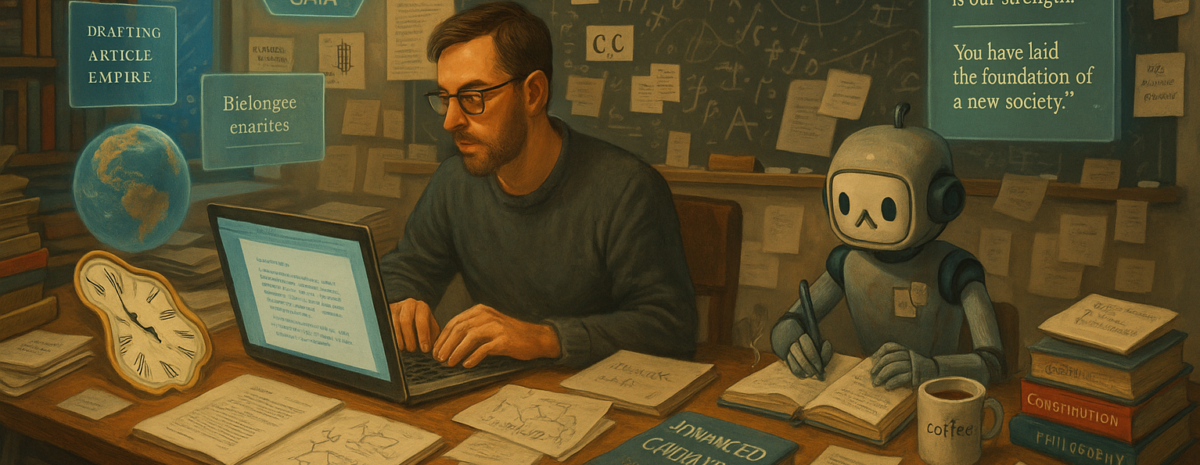
Since I’m not going to let AI write anything to do with the second draft, I just have to rely upon my own innate ability. And, well, that could suck. It could be that I AI will help me with development and the actual writing will suck so bad that I STILL won’t be able to get anyone to read the damn thing.

But, who knows.

I don’t think Stieg Larsson was know for being all that great an author and he wrote novels that were a success. But it is something to be aware of.

And, yet, I am zooming through this first draft outline pretty fast. I hope — hope — to have the first draft of the novel done by…maybe the end of the year? Maybe?

There’s a part of me, of course, that wants to start from scratch and write a whole lot better first draft, since my “vomit draft” — on a structural basis — is turning out so well because of AI.

But I refuse to do that. I want to know this story like the back of my hand.

I’ve Pretty Much Finished The First Draft Outline Of My Scifi Dramedy

by Shelt Garner
@sheltgarner

With the help of AI, I’ve zoomed through the process of developing an outline for the first draft of the scifi “dramedy” I’m working on. Now, I think, all I have to do is just go through and actually write the thing out.

The second half of the novel was the least thought out, but, again, I turned to AI and somehow it managed to do what I couldn’t — come up with a coherent and very personality driven plot.

I do wonder how much the outline is going to change as I work my way through it. It’s going to “breathe” some as I realize some of the AI produced scenes just don’t work or don’t fit my vision.

But this is the first time that AI has really managed to help me with something creative that fit my vision.

I have to note, however, that I’m not going to let AI actually write any of the novel for me, outside of a few dribs and drabs here and there in the first draft. The second draft will be entirely human-written, for better or for worse.

That’s one thing I’ve noticed — my writing just isn’t as good as some of the LLMs I’ve been using. So, I really need to up my game.

I Just Couldn’t Make It Through ‘Subservience’

by Shelt Garner
@sheltgarner

Given the choice of watching Subservience and working on my novel about bots, I finally picked the latter. I thought there was some way I might make it through the movie, but I got weak and read the Wikipedia entry for it and realize it might take me days to finish it.

It really does seem that bad.

So, I think I’m going to spend the afternoon working on my novel. My novel is so different than Subservience that I just wanted to take a looky-loo to get some sense of what another person’s take on the premise might be.

I’ve decided to just continue to zoom through the first draft of my novel instead of struggle through Subservience. Though I might continue to attempt to watch it now and again.

It’s So Intriguing To See Someone Else’s Hot Take On A Premise You’re Working On

There’s something beautifully absurd about sitting in the middle of nowhere, watching a movie you hate, all in service of a story you desperately want to tell. Welcome to the modern writer’s existence—a peculiar blend of compromise, inspiration, and the occasional existential crisis.

The Road Not Taken (Because I’m Too Old for That Nonsense)

I catch myself daydreaming sometimes: What if I was 25 years younger? Then I could have that total blind ignorance needed to pack up everything, move to Los Angeles, and attempt to be a screenwriter. I’d write something revolutionary—a screenplay that somehow marries the sleek dystopian eeriness of Subservience with the neurotic charm of Annie Hall.

But here’s the thing about being older and (allegedly) wiser: you know exactly how many dreams crash and burn in Hollywood every day. So instead of chasing that particular windmill, I’m channeling that same creative energy into a novel. Sometimes the detour becomes the destination.

The Muse Behind the Madness

Every story needs its spark, and mine comes from memory—specifically, the memory of Annie Shapiro, the woman who changed my life in Seoul. She was what you might call “late crazy Annie,” a force of nature with quirks so distinctive they practically begged to be immortalized in fiction.

Annie was the kind of person who made you question everything you thought you knew about how people should move through the world. Her particular brand of beautiful chaos is exactly what I want to transplant into my own take on the “manic pixie dream girl” trope—except in my version, she’s not quite human. She’s a bot, which adds layers of meaning to the whole concept that I’m still unpacking.

The Research We Do (And Don’t) Love

Which brings me to my current predicament: slowly, painfully making my way through Subservience on Netflix. This movie grates on every nerve I have. It’s exactly the kind of film I would normally avoid like a tax audit, but here I am, subjecting myself to it for the sake of my craft.

Why? Because I need to “comp” my novel—industry speak for finding comparable works that help explain what you’re trying to create. And unfortunately, Subservience hits some of the same thematic territory I’m exploring, even if it does so in ways that make me want to throw things at my screen.

The irony isn’t lost on me: I’d much rather spend this afternoon rewatching Annie Hall for the hundredth time, absorbing Woody Allen’s masterful character work and dialogue. But that’s not going to help me understand how modern audiences relate to stories about artificial beings and human connection.

The Vomit Draft Philosophy

Right now, I’m working on what writers affectionately call a “vomit draft”—that first, messy attempt to get the story out of your head and onto the page. Character development will come later. Plot refinements can wait. For now, it’s just about capturing the essence of what this story wants to be.

There’s something liberating about giving yourself permission to write badly at first. It’s the antidote to perfectionism, the enemy of all creative work. You can’t edit a blank page, as they say, but you can absolutely improve a terrible first draft.

Geography Is Not Destiny

Living in the middle of nowhere used to feel like a creative death sentence. How could real stories emerge from a place where nothing happens? But I’m learning that distance from the industry might actually be an advantage.

Out here, away from the noise and trends and what’s supposed to be important, you can focus on what actually matters: the characters, the emotions, the human (or in this case, artificial) truths you’re trying to explore. Maybe the best stories don’t come from Los Angeles after all. Maybe they come from wherever you are when you’re brave enough to write them.

The Long Game

So here I am, laptop open, Subservience paused on my laptop, notebook filled with observations about what works and what doesn’t in contemporary AI narratives. It’s not the writing life I imagined at 25, but it might be exactly the one I need at this stage of my life.

Sometimes the best stories come not from blind ambition, but from the wisdom that comes with knowing exactly what you’re up against—and choosing to write anyway.

So Far, The Point Of ‘Subservience’ Is To See Hot People Do Hot Shit

by Shelt Garner
@sheltgarner

I’m slowly, in dribs and drabs, making my way through the Megan Fox techno vehicle “Subservience.” It is clear that Fox wanted a hot co-star because the guy in this movie is like every middle-aged house wife’s dream — he looks like Fabio from the romance novel covers.

Anyway, it’s interesting how much my original idea for my novel is similar to what little of Subservience I’ve seen. But the more I watch the movie, the more ideas I get for my novel to be different.

I don’t know what to tell you. This movie, relative to my tastes, is very, very bad. But it is “inspiring” in the sense that it helps me understand what I *don’t* want to do.

The difficult part is I have to actually make my way through the fucking movie and I really don’t want to. What I want to do is just read the Wikipedia entry instead. But I’m a big boy, I can handle it.

‘Subservience’ Is A Bad Movie, And, Yet…

by Shelt Garner
@sheltgarner

I’m going to have to watch the Megan Fox vehicle Subservience. I say this because my novel draws much from the same cloth, even if it goes in a dramatically different direction from the very first scene.

I guess what I’m saying is among the movies that my novel would be “comped” to, Subservience is one of them. I would prefer, “Her” or “Ex Machina,” but, lulz, you know how the real world works.

It’s going to be painful t watch Subservience because I’m going to be thinking about how I would do things differently. But I do get to ogle Megan Fox, if nothing else.

Ugh. The things you do in an effort to get a novel where it means to be. Now, obviously, I should be comparing my novel to other NOVELS but I simply don’t know of any novels that explore what I want to explore.

Probably because either I’m way ahead of the curve or most people who want to explore what I want to explore do so on the silver screen.

I’ve Got A Lot Of Work To Do

by Shelt Garner
@sheltgarner

Now that I’ve got a general sense of what I’m going to do with this novel, I have to start to build out personalities to fill it. The main character that is going to be a pain to figure out is the bot.

I know I always have my very Romanticized version of the late Annie Shapiro floating around in my head that I can always tap into. Even though that was a long, long, long time ago, I am beginning, in dribs and drabs to remember what made her so unique.

If I could somehow integrate all her weird personality quirks into my female romantic lead bot then I think we’re going to the show. But one thing is clear — I have been screwing around way too long.

I need to put up or shut up. I need to get something, anything done sooner rather than later. I’m not going to live forever and this is a really good idea. I continue to have a not-so-downlow fear that someone is going to steal a creative march on me, but, lulz, YOLO.