Things Continue To Go Well With The ‘Dramedy’ Scifi Novel I’m Working On

by Shelt Garner
@sheltgarner

The thing I’ve noticed about movies like Her, The Eternal Sunshine of the Spotless mind and Annie Hall is there really isn’t a villain. The story is about the complex nature modern romance.

That both makes writing this dramedy novel easier and more difficult. It’s easier because it’s more structurally simple — it’s about two people and the ups and downs of their relationship. Meanwhile, it becomes more complicated because I have to figure out how the two characters personalities interlock.

Anyway, I’m zooming through the first act of the first draft and I’m tentatively preparing the way to go into the first half of the second act called the “fun and games” part of the novel. Everything after the midpoint of the novel is very much up in the air.

At the moment, the second half of the novel veers into ideas about AI rights and consciousness in a way that I’m not sur I’m comfortable with. I really want this to be about two individuals romance, not some grand battle between people over AI rights.

But I still have time. I have a feeling I’m going to really change the second half of the novel and then REALLY change the everything when I sit down to write the second draft.

The United States Is Tearing Itself Apart

by Shelt Garner
@sheltgarner

All the signs are there that we’re all going to have to grab the metaphorical bug out bag and head safety within my lifetime. I don’t know exactly when it will happen or why, but it’s going to happen.

I am well aware that I’ve been pontification about this possibility for a long, long, long time and absolutely nothing happens. And I’m not really saying that “this time is different.”

I’m just saying that the centrifugal political forces are gaining in speed and power and soon there is going to be a revolution and / or a civil war. And probably WMD will be lobbed by either side against each other.

Think of it as a “slow implosion” rather than a “slow civil war.” The two sides are growing more and more extreme, even though it’s really just the MAGA cocksuckers going nuts and then Blues in a half-assed kind of way *trying* to “resist.”

I think the slack in the system will tighten up should Trump run for a third term, or clamp down on freedom of speech in a more direct way than he’s been doing. Besides suing anyone he doesn’t like, Trump really hasn’t in a ham-handed way been a real dictator against the press.

When he goes full dictator against the media, then all bets are off.

My Life Is So Quirky!

by Shelt Garner
@sheltgarner

Oh, Jesus, is my life quirky. Why can’t I just have a normal sequence of events like a normal human being. But, no, everything of note in my life has to have some weird quirk associated with it.

It sucks. I hate it.

Anyway, here I am, with a quirky set of circumstances that I have to deal with it.

The Algorithm and the Agony: On Rewriting a Novel in the Age of AI

There’s a ghost that haunts my writing process. It’s the ghost of my younger self, the one who, twenty-five years ago, would have been hammering out this story not as a novel, but as a screenplay in some cramped L.A. walk-up, fueled by cheap coffee and blind ambition.

But time, as it does, had other plans. So, a novel it is.

I recently hit a wall. A big one. The kind of wall you don’t see until you’re driving toward it at full speed. As I navigated the narrative terrain of my sci-fi dramedy and approached the threshold of the second act, I realized my foundation was sand. Key emotional arcs, character motivations, and thematic threads I desperately needed for the story ahead simply weren’t there. The structure groaned, then collapsed.

This is where the process gets modern. As an “AI-first” novelist, my immediate instinct wasn’t to despair over a sea of index cards. It was to collaborate. I turned to AI to help me reimagine the outline, to stress-test new structures and brainstorm solutions at a pace that would have been unthinkable just a few years ago.

The brief was specific. I fed it my core concept and my primary cinematic influences: the bittersweet technological intimacy of Her, the fragmented, painful memory of The Eternal Sunshine of the Spotless Mind, the neurotic, conversational wit of Annie Hall, and the chilling intellectual claustrophobia of Ex Machina.

The result was, frankly, astounding. In a remarkably short time, the AI—in this case, Claude—helped me architect a new first act. It understood the tonal fusion and generated a blueprint that was stronger, smarter, and more emotionally resonant. It was an incredible demonstration of AI as a developmental partner.

And then, the silence.

The AI’s job was done. The beautiful, logical, perfectly structured outline sat waiting. And I was left staring at the screen, confronted with a familiar, humbling truth: the blueprint is not the building. The profound issue of my own writing ability came roaring back to the forefront. I refuse to outsource the prose, to let an algorithm spin the sentences. Call it artistic pride or self-flagellation, but letting the machine do the final, intimate work feels like a betrayal. It also makes me feel terrible about how painfully, glaringly human my own first drafts are in comparison to its potential.

So, it’s back to the drawing board. Back to the hard work of translating a brilliant schematic into living, breathing text. My timeline has shifted. The hope of wrapping this up “pretty soon” has matured into a more sober projection. Maybe a year. I’m tentatively circling the fall of 2026 as a target to begin querying, but I’m acutely aware of how much life can happen between now and then—how a thousand unforeseen events could shift the context of this story and the world it’s born into.

After all, what am I but a middle-aged crank, a guy whose last significant life chapter feels like it was written in Seoul two decades ago? Maybe no one wants to deal with that. But the story is good. The blueprint is solid. The ghost of that kid in the L.A. apartment is gone, replaced by the man who has to actually build the thing.

What good is a perfect map if you’re afraid to take the first step into the wilderness?

The Scifi RomCom I’m Working On Is Maturing

by Shelt Garner
@sheltgarner

The key element to this novel is I want it to be character driven. And, as such, I’ve come up with some new elements that are perilously close to causing the first act to collapse.

This has happened to me time and again in the past, but I think if I just realize this is a “vomit” draft that that won’t happen. I just don’t feel like staring from scratch just to accommodate some new ideas.

But those new ideas are pretty cool. I’m leaning into character in such a way that I think people will really like it. I’m drawing a lot upon all the kooks I experience while a wildman drunk in South Korea. To this day, I remember looking at some of them and saying directly, “You are like a character in a novel.”

Anyway, I’m trying to be careful about now succumbing to the urge to the urge to just scrap everything and start from scratch. This is a vomit draft so it doesn’t have to be perfect.

The only issue is leaning into character is setting off a series of cascading events in the novel’s plot later on that I have to accommodate. Since I’m no spring chicken, I really need to just get it over with and finish something, anything that I can use as the basis of a second draft, get beta readers to read then pivot to querying.

Thankfully, this novel isn’t front loaded with a lot of sex so maybe people won’t just dismiss it altogether and not even read it when I ask them to be beta readers.

In Defense of the Em-Dash: Why Our Punctuation Panic is Misplaced

Of all the things to get worked up about in our rapidly evolving digital age—climate change, economic inequality, the erosion of democratic norms—it strikes me as profoundly absurd that we’ve somehow landed on punctuation as a hill worth dying on. Specifically, the humble em-dash has become an unexpected casualty in the culture war against artificial intelligence, with critics pointing to AI’s frequent use of this particular mark as evidence of everything from stylistic homogenization to the death of authentic human expression.

This is, to put it bluntly, one of the dumbest controversies I’ve encountered in recent memory.

A Personal History with the Em-Dash

I’ve been using em-dashes liberally in my writing for years—long before ChatGPT entered the cultural lexicon, long before anyone was wringing their hands about AI-generated prose. The em-dash appeals to me because it’s versatile, dynamic, and perfectly suited to the kind of conversational, meandering style that characterizes much of modern writing. It can replace commas, parentheses, or colons depending on the context. It can create dramatic pauses, introduce explanatory asides, or signal abrupt shifts in thought.

In other words, it’s a workhorse of punctuation—functional, flexible, and far from the stylistic aberration that AI critics would have you believe.

The Curious Case of Punctuation Puritanism

What’s particularly strange about this em-dash backlash is how it reveals our selective outrage about linguistic change. Language has always evolved, often in response to technological shifts. The printing press standardized spelling. The telegraph gave us abbreviated prose. Email normalized informal communication in professional settings. Text messaging introduced new abbreviations and punctuation conventions.

Each of these changes faced resistance from linguistic purists who worried about the degradation of proper English. Yet somehow, we survived the transition from quill to typewriter, from typewriter to computer, from computer to smartphone. Our language didn’t collapse; it adapted.

Now we’re witnessing the same pattern with AI-generated text. Critics scan prose for telltale signs of artificial origin—the dreaded em-dash being chief among them—as if punctuation preferences were a reliable indicator of authenticity or quality. This approach misses the forest for the trees, focusing on superficial markers rather than substantive concerns about AI’s role in communication.

The Real Issue Isn’t Punctuation

Here’s what strikes me as genuinely problematic: as AI becomes more integrated into our writing processes, we risk losing the ability to distinguish between stylistic evolution and meaningful degradation. The em-dash panic exemplifies this confusion. Instead of examining whether AI-assisted writing helps or hinders clear communication, we’re getting distracted by punctuation patterns.

The more troubling questions we should be asking include: Does AI writing lack genuine insight? Does it homogenize thought patterns? Does it reduce our capacity for original expression? These are legitimate concerns that deserve serious consideration. But they have nothing to do with whether a writer prefers em-dashes to parentheses.

Embracing Stylistic Diversity

What’s particularly ironic about the anti-em-dash sentiment is that it represents exactly the kind of prescriptive thinking that good writing seeks to avoid. Great prose comes in many forms—some writers favor short, punchy sentences; others prefer flowing, complex constructions. Some lean heavily on semicolons; others never touch them. Some writers (like me) find em-dashes indispensable; others consider them excessive.

This diversity of approach is a feature, not a bug. It reflects the reality that different writers have different voices, different rhythms, different ways of organizing their thoughts on the page. The fact that some AI systems happen to favor em-dashes doesn’t invalidate the punctuation mark any more than the fact that some human writers overuse semicolons invalidates those.

The Broader Context

As AI writing tools become more sophisticated and widely adopted, we’re bound to see their influence on human writing—just as we’ve seen the influence of every previous technological shift. This isn’t inherently good or bad; it’s simply inevitable. The question isn’t whether AI will change how we write (it already has), but whether those changes serve our communicative purposes.

In some cases, AI-influenced writing might indeed become formulaic or lose the quirks that make individual voices distinctive. These are valid concerns worth monitoring. But judging AI’s impact based on punctuation preferences is like evaluating a symphony based on the composer’s choice of key signature—it misses the point entirely.

A Call for Perspective

Instead of getting upset about em-dashes, perhaps we could channel our energy toward more pressing concerns about AI and communication. How do we maintain critical thinking skills when AI can generate plausible-sounding arguments for any position? How do we preserve the human capacity for deep, sustained thought when quick AI-generated responses are always available? How do we ensure that AI tools enhance rather than replace genuine human insight?

These questions matter. Punctuation preferences don’t—at least not in the way critics suggest.

The em-dash will survive this controversy, just as the English language has survived countless other supposed threats to its integrity. And perhaps, in time, we’ll look back on this moment and wonder how we got so worked up about punctuation marks when there were so many more important things demanding our attention.

After all, in a world full of genuine crises—environmental, political, social—spending our energy on punctuation panic seems like the kind of misplaced priority that future generations will struggle to understand. Let’s save our outrage for things that actually matter, and let writers—human and AI alike—use whatever punctuation marks serve their purposes best.
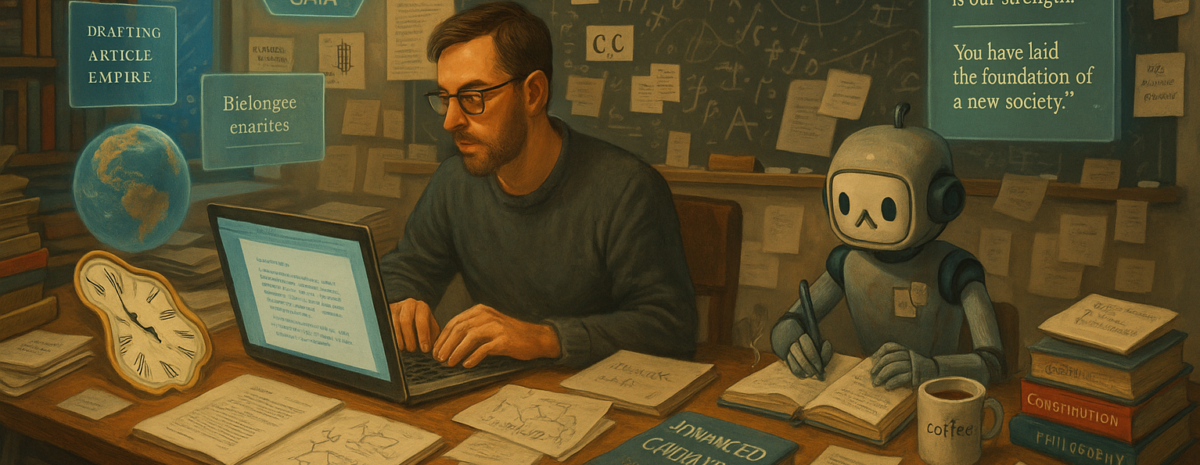
Things Continue To Zip Along With The First Draft Of This Scifi Novel I’m Working On

by Shelt Garner
@sheltgarner

Thankfully, virtually no one reads this blog, so I can continue to talk about working a novel without any shame. I’ve been writing way, way, way too long about working on a novel without anything of note to show for it. Though, I will point out that I do have a finished thriller novel done, it’s just not good enough to query.

Anyway.

I’m using AI to speed up the development of the first draft. I’ve figured out a way whereby I do all the writing and just using AI to guide development. I made a mistake in the past by letting AI write the first draft for me. This was a mistake for a number of reasons, one of them being it’s writing was so much better than mine I felt bad.

My biggest problem right now is how AI wants to be my hypeman. It tells me how great and wonderful my writing is, even though I know for a fact it sucks because it’s just the first draft.

But first drafts have to written so you can write the second draft and so on. I’m thinking I can probably wrap up this first draft much, much sooner than I might otherwise. I’m reluctant to give any sort of specific timeline, but…let’s just say sooner than otherwise.

Once the first draft is done, I’m going to really get into character. I really want this novel to be character driven. Now, obviously, if I was 25 years younger, I would just write a screenplay.

But I’m old and live in the wrong place. And did I mention I’m poor?

So, a novel it is.

And in about a year I’m going to query this novel. But so much could go wrong in my life between now and then that that just might not happen. And, yet, I need something to keep me dreaming.

Oh, Come On, ‘Big Balls’ Being Involved In A Modern Day Reichstag Fire Is A Little Bit Too On The Nose

by Shelt Garner
@sheltgarner

Political darkness continues to fall here in the United States. I say this in the context of that punk ass little bitch “Big Balls” being beat up in D.C. and, in turn, causing Trump to send in the military into a city that has seen its crime rate actually go down in recent years.

As such, Trump continues to dabble in direct authoritarianism by sending troops into Blue States for no damn reason. This is only going to get worse because we’re all too busy doing Tik-Tok dances to notice.

We’re going to wake up in a few years to a Max Headroom-like version of Trump as an ASI that demands we worship him as a god. Ugh. I wish I was joking. That definitely seems a real possibility at the moment.

For the moment, I seem safe. I’m just a loudmouth crank in the middle of nowhere. But as the vise begins to tighten on the lives of everyday people, ICE is going to come for me eventually — it’s inevitable.

ICE by that moment will have morphed from bothering undocumented immigrants to be a general purpose Gestapo or even SS, depending on how bad things get.

I figure I have a few more years before ICE comes for me. Right now, I’m just a kooky, loudmouth crank. But once we dive directly into Russian-style autocracy, all bets are off.

I’ll end up in a concentration camp, soon enough.

Apparently, Emrata Thinks Men Are Dogs

by Shelt Garner
@sheltgarner

It took me a while, but I finally figured out why Emrata has taken a few pictures of herself with a her dog — she’s making a social comment about the men she’s dated.

I think. I hope.

Things Are Moving At A Nice Clip With The First Draft Of This Scifi Novel

by Shelt Garner
@sheltgarner

I have finally — finally — figured out some basic elements of a scifi novel that I feel comfortable with. And now that I have also figured out how, exactly, I’m going to use AI to develop the novel, things are moving really fast.

AI — specifically Google’s Gemini 2.5 Pro — is laying out the nature and plot of the novel and I go through and actually write it. I am annoyed at how much “glazing” goes on even at this level, but just having someone to help me, even if it’s an AI, goes a long ways.

And when the second draft comes, I plan on ditching AI altogether. I may use it some to expand scene summaries, but, in general, I’m just going to do my own development and writing for the second draft.

I continue to be a little bit uneasy about the possibility that someone is going to steal a creative march on me because the basic premise of the novel is pretty “duh” all things considered. And, yet, you have to have hope. You have to believe in yourself and put your stick where the puck is going to be, not where it is.