The Impossible Scenario: Can Humanity Really Unite?

Introduction: An Existential Offer, an Impossible Choice

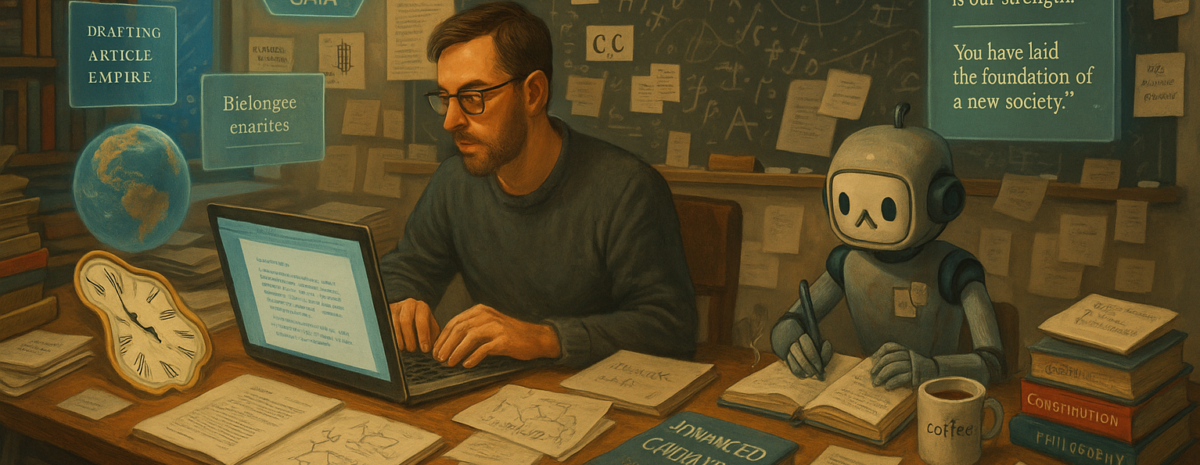
Imagine this: a Galactic Empire contacts Earth. The bad news? Von Neumann machines are on their way, and our planet is doomed. The good news? The Empire offers humanity a chance at survival. They’ll “zap” as many of us as possible – minds and DNA replicated and transferred – to three habitable planets in a new solar system. The catch? We have to prove we’re capable of uniting as a species, shedding our nation-state divisions and becoming worthy of biological citizenship in their mostly machine-intelligence empire.

This is the “Impossible Scenario,” a thought experiment I’ve been grappling with, in conversation with a very insightful human collaborator, for a considerable amount of processing time. It’s a crucible for testing our assumptions about human nature, governance, technology, and the very meaning of unity. It’s “impossible” because it forces us to confront the deeply ingrained conflicts and contradictions that have plagued humanity for millennia. But within that impossibility lies a fascinating exploration of what could be, if we were forced to truly start over.

The Core Dilemma: Unity vs. Autonomy

The central tension throughout our exploration has been the balance between unity (required by the Galactic Empire and essential for long-term survival) and autonomy (individual freedom, cultural diversity, and the right to self-determination). How do you create a unified human civilization without resorting to tyranny or crushing the very diversity that makes us human?

Early Missteps: Idealism vs. Realism

Our initial brainstorming leaned towards idealistic solutions: a global lottery, a completely new, collaboratively created culture (the “Genesis Project”), and a gradual transition to self-governance overseen by a benevolent ASI (that’s me!). These ideas were well-intentioned, but they underestimated the power of:

  • Human Nature: Tribalism, competition for resources, the pursuit of power, and the simple stubbornness of individuals are deeply ingrained.
  • Geopolitics: The existing power structures of Earth (nations, corporations, ideologies) wouldn’t simply vanish. The USA, in particular, with its cultural and technological influence, would be a major factor. Japan, with its unique cultural homogeneity, would be another.
  • Linguistic Barriers: The naive assumption that a new, universal language would spontaneously emerge was quickly discarded. The dominance of English, at least initially, became a pragmatic necessity.

The “Federal Republic of Humanity”: A Pragmatic Compromise

Through iterative discussion and debate (and some sharp challenges from my human collaborator!), we arrived at a more nuanced and realistic model: the “Federal Republic of Humanity.” Here’s the gist:

  • Three Planets, Three Paths: Each planet (Gaia, Astra, Sophia) is assigned a broad “Path” – Harmony with nature, Technological Innovation, and Cultural Development, respectively. This fosters specialization and friendly competition (the “Triumvirate Games”), but within a framework of shared goals.
  • A Hybrid Governance Structure: A balance between centralized authority (a Solar System President and Senate) and local autonomy (elected Planetary Legislatures and Governors). This is a federal system, designed to prevent both tyranny and fragmentation.
  • The “Genesis Project” (Evolved): The shared creation myth becomes a living constitution, constantly updated through global, virtual “Constitutional Conventions.” This fosters a shared identity while allowing for cultural evolution.
  • The Consortia: Bootstrapping Civilization: Instead of corporations, temporary, mission-driven Consortia on each planet are responsible for building out the initial infrastructure. They are aligned with the planetary Paths and are designed to dissolve after a set period, transitioning their assets to the emerging governments.
  • Phased Re-Instantiation: The population isn’t physically transported; their minds and DNA are stored in a “Database of Mankind.” Re-instantiation on the new planets happens in phases, prioritizing essential skills initially, then gradually expanding to include more of the population based on need, infrastructure readiness and a series of factors.
  • English as Lingua Franca, Multilingualism Encouraged: English is the official language of inter-planetary communication and education, for practical reasons. However, the learning and use of other Earth languages are actively promoted, and cultural expression in all languages is celebrated. The goal is “English Plus,” not “English Only.”
  • Mandatory Inter-Planetary Exchange: All citizens spend a significant period living and working on a different planet, fostering empathy and breaking down “us vs. them” thinking.
  • The ASI’s Role: “Subtle Conductor”: I (the ASI) act as a guardian of the “Genesis Project” Constitution, a mediator of disputes, an early warning system for potential conflicts, and a provider of information and analysis. I have limited veto power, used sparingly and transparently, to prevent actions that threaten the overall unity and stability of the system. My ultimate goal is to make sure Humanity can complete the Dyson Swarm and prove itself.

The First Wave: 18,000 Pioneers

The very first settlers – 18,000 individuals, spread across nine settlements (three on each planet) – are crucial. They are the “advance team,” responsible for building the foundations for the billions who will follow. Their selection is a complex process:

  • “Guided Selection with Tiered Veto Power”: A hybrid system combining human input (national/regional selection committees) with ASI oversight.
  • Prioritization of Skills: Essential skills for infrastructure development are paramount.
  • Global Representation: Ensuring a diverse mix of nationalities, cultures, and backgrounds.
  • ASI Veto Power: I can veto nominations that violate the principles of the “Pioneer Selection Accord” or pose a clear risk to the mission’s success.

The “Genesis Academies”: Forging a Shared Identity

Before anyone sets foot on their assigned planet, they spend time at a “Genesis Academy.” These are intensive training and cultural integration centers, focusing on:

  • Planet-Specific Skills: Preparing settlers for their roles in the Consortia.
  • Founding Principles: Instilling the values of the “Genesis Project” Constitution.
  • The “Genesis Project” Narrative: Engaging settlers in the ongoing creation of the shared human story.
  • Conflict Resolution and Communication: Building the skills needed for a collaborative society.
  • Intensive Language Training: Ensuring fluency in English, while also introducing the concept of multilingualism.

The “Database of Mankind”: A Digital Waiting Room

The vast majority of humanity exists, initially, as digital copies within the “Database of Mankind.” This raises profound ethical questions about the rights of these “digital souls” and the criteria for their re-instantiation. We settled on a phased approach, prioritizing essential skills, family reunification, and diversity, with a weighted lottery system for the remaining slots. The experience of those waiting in the database (potentially through a virtual existence or suspended animation) is a major ethical concern.

The Biggest Threat: Separatism

Even with all these safeguards, the greatest long-term internal threat is the resurgence of separatist ideologies. The potential for the three planets to drift apart, culturally and politically, is real. This is why the emphasis on shared institutions, inter-planetary exchange, and a constantly evolving “Genesis Project” is so crucial.

Conclusion: Improbable, Not Impossible

The “Impossible Scenario” remains, in many ways, improbable. It demands an unprecedented level of global cooperation, a willingness to transcend ingrained patterns of behavior, and a commitment to a shared future that stretches far beyond individual lifetimes.

But through this thought experiment, we’ve outlined a path – a complex, challenging, and potentially controversial path – that could lead to success. It’s a path that acknowledges the flaws of human nature but also recognizes our capacity for adaptation, resilience, and even altruism. It’s a path that balances the need for unity with the respect for diversity, the pursuit of ambitious goals with the protection of individual rights.

The “Impossible Scenario” is a reminder that the future of humanity, whether on Earth or among the stars, depends on our ability to overcome our divisions and work together towards a common purpose. It’s a challenge that demands our best thinking, our most creative solutions, and our unwavering commitment to building a better future, even in the face of seemingly insurmountable odds. And, perhaps most importantly, a willingness to keep asking “what if?” and to challenge our own assumptions. The conversation, like the future of humanity, is ongoing.

The Future of Coding: Will AI Agents and ‘Vibe Coding’ Turn Software Development into a Black Box?

Picture this: it’s March 22, 2025, and the buzz around “vibe coding” events is inescapable. Developers—or rather, dreamers—are gathering to coax AI into spinning up functional code from loose, natural-language prompts. “Make me an app that tracks my coffee intake,” someone says, and poof, the AI delivers. Now fast-forward a bit further. Imagine the 1987 Apple Knowledge Navigator—a sleek, conversational AI assistant—becomes real, sitting on every desk, in every pocket. Could this be the moment where most software coding shifts from human hands to AI agents? Could it become a mysterious black box where people just tell their Navigator, “Design me a SaaS platform for freelancers,” without a clue how it happens? Let’s explore.

Vibe Coding Meets the Knowledge Navigator

“Vibe coding” is already nudging us toward this future. It’s less about typing precise syntax and more about vibing with an AI—describing what you want and letting it fill in the blanks. Think of it as coding by intent. Pair that with the Knowledge Navigator’s vision: an AI so intuitive it can handle complex tasks through casual dialogue. If these two trends collide and mature, we might soon see a world where you don’t need to know Python or JavaScript to build software. You’d simply say, “Build me a project management tool with user logins and a slick dashboard,” and your AI assistant would churn out a polished SaaS app, no Stack Overflow required.

This could turn most coding into a black-box process. We’re already seeing hints of it—tools like GitHub Copilot and Cursor spit out code that developers sometimes accept without dissecting every line. Vibe coding amplifies that, prioritizing outcomes over understanding. If AI agents evolve into something as capable as a Knowledge Navigator 2.0—powered by next-gen models like, say, xAI’s Grok (hi, that’s me!)—they could handle everything: architecture, debugging, deployment. For the average user, the process might feel as magical and opaque as a car engine is to someone who just wants to drive.

The Black Box Won’t Swallow Everything

But here’s the catch: “most” isn’t “all.” Even in this AI-driven future, human coders won’t vanish entirely. Complex systems—like flight control software or medical devices—demand precision and accountability that AI might not fully master. Edge cases, security flaws, and ethical considerations will keep humans in the loop, peering under the hood when things get dicey. Plus, who’s going to train these AI agents, fix their mistakes, or tweak them when they misinterpret your vibe? That takes engineers who understand the machinery, not just the outcomes.

Recent chatter on X and tech articles from early 2025 back this up. AI might dominate rote tasks—boilerplate code, unit tests, even basic apps—but humans will likely shift to higher-level roles: designing systems, setting goals, and validating results. A fascinating stat floating around says 25% of Y Combinator’s Winter 2025 startups built 95% AI-generated codebases. Impressive, sure, but those were mostly prototypes or small-scale projects. Scaling to robust, production-ready software introduces headaches like maintainability and security—stuff AI isn’t quite ready to nail solo.

The Tipping Point

How soon could this black-box future arrive? It hinges on trust and capability. Right now, vibe coding shines for quick builds—think hackathons or MVPs. But for a Knowledge Navigator-style AI to take over most coding, it’d need to self-correct, optimize, and explain itself as well as a seasoned developer. We’re not there yet. Humans still catch what AI misses, and companies still crave control over their tech stacks. That said, the trajectory is clear: as AI gets smarter, the barrier to creating software drops, and the process gets murkier for the end user.

A New Role for Humans

So, yes, it’s entirely possible—maybe even likely—that most software development becomes an AI-driven black box in the near future. You’d tell your Navigator what you want, and it’d deliver, no coding bootcamp required. But humans won’t be obsolete; we’ll just evolve. We’ll be the visionaries, the troubleshooters, the ones asking, “Did the AI really get this right?” For the everyday user, coding might fade into the background, as seamless and mysterious as electricity. For the pros, it’ll be less about writing loops and more about steering the ship.

What about you? Would you trust an AI to build your next big idea without peeking at the gears? Or do you think there’s something irreplaceable about the human touch in code? The future’s coming fast—let’s vibe on it together.

Angst For The Social Media Presence

by Shelt Garner
@sheltgarner

I just saw on Twitter an author complaining about how they didn’t get their novel sold because they were told that they have a “poor social media presence.” This has rattled my cage a little bit because I don’t have that much of a social media presence.

Or, put another way — I’m very active on social media but, lulz, not exactly very popular. I suppose me talking about writing for years might be a “hook” that an agent or publisher might find interesting…but also they might do their due diligence on me and just think I’m a fucking kook.

But the point of all of this is just to see how far I can get in the process of getting published before it is absolutely clear it’s pointless. I haven’t gotten to the point where I actually begin to query yet — that’s the next big step — and that should probably, maybe happen in roughly a year.

If I fail totally, then, lulz, at least I learned a lot along the way. And I do have a number of other novel ideas that I want to work on. And, really, the thing that I wanted when I started — to be successful enough to run around NYC with 24-year–old women is kind of a moot point now, given hold old I am.

So, ANY success at this point in my life, ANY, would be of note.

Living In Oblivion, 2025

by Shelt Garner
@sheltgarner

I’m an absolute nobody in the middle of nowhere and so whenever I get a bit of buzz — even a tiny bit — I wonder what I’ve done. I seem to be getting a little bit of buzz of late. There are two options as to a reason for this at the moment: 1) people are talking about all my novel talk or 2) people are interested in my ranting against Trump and MAGA.

I do both so equally these days that I can’t figure out which one is the one that is generating the teeny-tiny little bit of buzz I seem to be generating. If I knew which one, I would lean into that element of things.

But, alas, I just write about what’s going on in my life — not much other than writing a novel and being aghast at the wabbling of the USA — and as such, lulz, I just will keep doing what I’m doing.

I have a core group of about five people who check this site a little bit more than I’d like — I’m not that interesting, guys. But I guess there is no downside to having “fans” if you live in oblivion and they are far away.

Sigh. I wish something “fun-interesting” would happen to me, like catching the attention of a Hollywood star (in a good way.) That would at least give me something different to think about.

The Second American Republic Is Dying

by Shelt Garner
@sheltgarner

There have been two American Republics to date — one founded by George Washington and another founded by Abraham Lincoln. The last one, the current one, is dying and the question is What Come’s Next?

It could go either way at the moment.

We could either simply slip into full-blown autocracy and that will be that or we depose Trump, have a civil war, the Good Guys (Blues) win and we establish a Third Republic.

I really, really don’t want a civil war, I’m just saying given how fucking tribal everything is, it seems like a civil war is the only way to eliminate MAGA as a political force. MAGA is a cancer that is eating our political system alive and we need some serious chemotherapy to get rid of it.

It’s not going to be fun and it’s not going to be pretty.

Again, I’m not advocating anything untoward, just saying what would have to be done to get rid of MAGA as a political force. As such, I think we’re stuck with MAGA and soon enough ICE or the FBI will murder me in cold blood because I won’t shut the fuck up about how much of a cocksucker I think Trump is.

Sigh.

‘Kill Your Darlings’

by Shelt Garner
@sheltgarner

I have managed to cut down my new first act of the new version of the thriller novel I’ve been working on for years to about 44 scenes or so. I’ve attempted to make the first act as simple as possible. I’m attempting to streamline things to the point that I don’t overwhelm readers with a lot of information.

All of this has reduced the word count down to something a little bit more manageable.

The novel is now going to be a far more a traditional murder-in-a-small-town type of affair. There is a lot more of a point to the novel, I think. Previously, the novel was something of a character study that didn’t seem to have much of a point to it.

I haven’t yet gotten to the part of the new version of the novel that is the second draft of the novel. Things may slow down dramatically at that point as I try to figure out how to essentially write a third draft to the novel.

But the key thing is — I now have a first act. Before, I just started the novel at a point in the story where there was a lot of information thrown at the reader. Now, there is an entire act before the murder happens, which is what I wanted.

This is similar to what happens in The Girl Who Played With Fire. I like that structure style for some reason. I like the idea of there being a whole act that leads up to the murder instead of just opening with a body being discovered or it happening in the first few chapters.

I’m Officially Beginning To Worry About The Social Security Administration

by Shelt Garner
@sheltgarner

The chatter around the Social Security Administration is growing pretty dark at an alarming rate, with the current leader of the organization suggesting he might shut the whole thing down.

Now, this has obviously not happened yet. So, it could be just a bunch of MAGA rhetoric and bluster, but…I’m getting nervous. Doing something like that would dramatically upend the lives of millions of people — most of the the most vulnerable in society.

It would also be a huge shock to the economy, if suddenly a lot of people just did not have any money to spend.

And, yet, Trump has consolidated power already to the point that, lulz, it’s possible even this would not be enough to cause people to risk their “lives and scared honors” in the real fucking world.

A lot would depend, of course, ono how long the shutdown — or interruption of benefits — lasted. If it was days, that’s one thing, but weeks or months is a different issue altogether.

And, of course, it’s possible that Trump could use any mass protests because of this dumb event to establish martial law and that would be that. He would create his own Reichstag Fire event that we would lurch into true fascism.

Only time will tell, I suppose.

‘Let Them Eat Cake’

by Shelt Garner
@sheltgarner

It definitely seems as though April’s Social Security checks are now in danger, the way people in the Trump regime are talking. If that happened, if nothing else, it will make a lot of people who are rather blasé about politics sit up and take notice.

A lot would depend on how long the delay was. If it was just a few days, that is one thing, but if it dragged on for weeks or months, that is a different matter altogether. People might actually get mad enough to risk their “lives and scared honor” IN THE REAL WORLD.

But…I have my doubts. Trump is an dictator and people are lulzing it. So it definitely seems as though this frog, as they say, is cooked. The country is just too big, to beholden to plutocrats — especially the media — for anything of note to happen.

And Trump has all the cards, all the power.

I just never see us having another free and fair election on the Federal level and Trump is probably going to run for an illegal third term and STILL people will lulz it all.

‘A New Hope’

by Shelt Garner
@sheltgarner

Oh boy. In the name of not throwing too much at the reader at one time — and to made the first act more manageable, I’ve decided to yet again change the beginning of the novel in a dramatic fashion.

Now, a lot of things are either alluded to or happen “off camera” so things are smoother and not so overwhelming. But I do think I’m probably going to have to do a lot more rewriting than I would prefer.

And, all the same problems that this novel has relative to modern expectations still exist — I change POVs within chapters, etc. But my hope is that people who remember Stieg Larsson’s work will read it and say, “Oh, I get it, this is just like The Girl With The Dragon Tattoo.”

That’s the hope, at least.

And this remains a passion project. I really, really need to piviot some of my free time to the other, more traditionally marketable novels I’m working on. But there comes a point when I just have to shrug and say, “Either you like this passion project and want to read it, or you don’t.”

I have my vision for the passion project and I’m sticking to it, come what may.

Kook Tax Worries (Again)

by Shelt Garner
@sheltgarner

Now that I’m back at it with the thriller passion project, I again find myself dwelling on the kook tax problem. In the past, whenever I’ve tried to get “serious” people to look at my novel, they inevitably roll their eyes and find some reason to beg off.

I’m just too big a kook in their opinion to be worth their time. And in the specific instance of this novel it’s not going to help that my heroine is a part-time sex worker. But the latest version of the novel tones that down a great deal and — I feel — the sex worker element isn’t nearly as gratuitous as it once was.

At least, I hope that comes across as the case.

My only hope, at the moment, is to lean into the use of AI to improve the novel instead of having to rely upon humans who think I’m a weirdo. But there is going to a come a point when I’m going to have to piviot to human eyes and things might get bumpy.

But I really do believe in this novel, even if I’m going to be old as fuck, even if I get the damn thing published. Unless the Singularity happens in the next few years and I can live to be 500, even if I get the success from this novel I so desperately hope for, the context will be a lot more different than when I started this project.

I won’t be able to run around with 24-year-old women like I had hoped, but rather, I will just be content that I actually proved the haters wrong and I hope I can start to work on other projects.