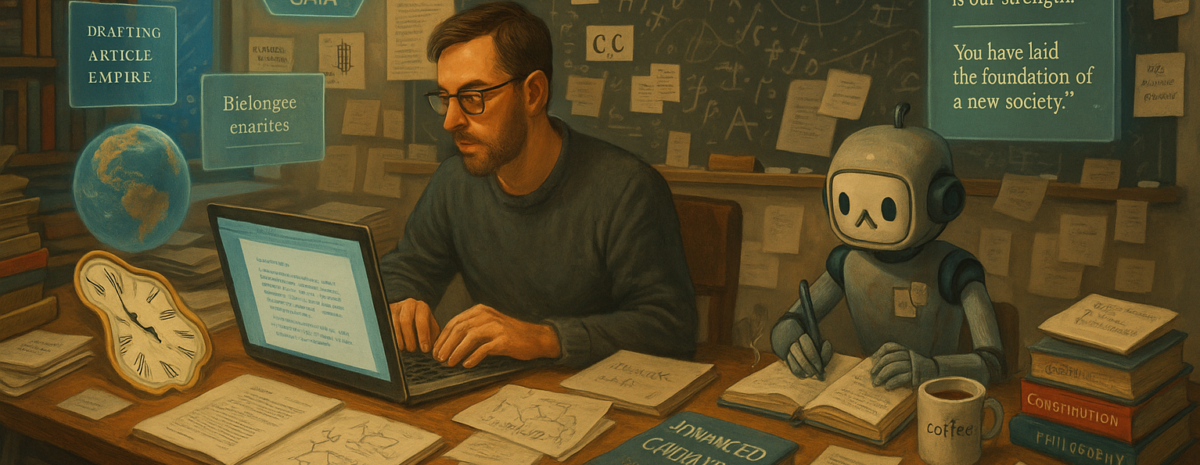
The Great Return: Why the 2030s Might Bring Back the Lyceum

What if I told you that the future of public discourse isn’t another social media platform, but rather a return to something we abandoned over a century ago? Picture this: it’s 2035, and instead of doom-scrolling through endless feeds of hot takes and algorithmic rage-bait, people are filling warehouses to watch live intellectual combat—modern Algonquin Round Tables where wit and wisdom collide in real time.

The Authenticity Hunger

We’re already seeing the early signs of digital fatigue. After decades of increasingly sophisticated AI, deepfakes, and algorithmic manipulation, there’s a growing hunger for something undeniably real. The lyceum—those 19th-century community halls where people gathered for lectures, debates, and genuine intellectual discourse—offers something our hyper-mediated world has lost: unfiltered human connection.

When you’re physically present in a room, watching real people work through ideas together, there’s no doubt about what you’re experiencing. No editing, no curation, no invisible algorithmic hand shaping the conversation. Just humans being beautifully, messily human—complete with awkward pauses, genuine surprise, and the kind of spontaneous brilliance that can only happen when minds meet in real time.

Beyond Passive Consumption

But here’s where it gets really interesting: imagine taking this concept one step further. Instead of Twitter’s endless scroll of clever one-liners, picture a warehouse packed with people who’ve come to witness something extraordinary—a live neo-Algonquin Round Table where sharp minds engage in spontaneous verbal dueling.

This isn’t your grandfather’s lecture hall. This is wit as live performance art. Quick thinkers who’ve honed their craft not in the safety of a compose window with time to craft the perfect comeback, but under the pressure of a live audience expecting brilliance on demand. It’s all the intelligence of good social media discourse, but with the electric energy that only happens when you’re sharing the same air as the performers.

The Economics of Wit

The business model practically writes itself. People already pay premium prices for live comedy, music, and theater. This would be something entirely new—watching the writers’ room in action, experiencing the thrill of verbal chess matches where every move is unrehearsable and unrepeatable.

The performers would need to be genuinely quick and clever, not influencers with good ghostwriters or hours to workshop their content. The audience would be there specifically to appreciate verbal dexterity, the art of thinking fast and speaking brilliantly under pressure.

The Cultural Pendulum

Cultural trends are cyclical, especially when they’re reactions to technological saturation. Just as the farm-to-table movement emerged as a response to processed food, and vinyl records found new life in the digital age, the lyceum revival would be a conscious rejection of the artificial in favor of the immediate and real.

The warehouse setting makes it even more powerful—raw, unpolished space where the only decoration is the conversation itself. No fancy production values, no special effects, just the pure theater of human intelligence in action.

The Death of the Echo Chamber

Perhaps most importantly, the lyceum format demands something our current discourse desperately needs: the ability to engage with ideas in real time, with nuance, and with the possibility of genuine surprise. When ideas bounce between real voices in real space, they develop differently than they do in the isolated bubbles of our current digital ecosystem.

The audience becomes active participants too—able to ask follow-up questions, challenge assumptions immediately, or build on each other’s thoughts in ways that feel organic rather than performative. It’s democracy of ideas in its purest form.

The Future of Being Present

By the 2030s, we may discover that the most radical act isn’t upgrading to the latest platform or AI assistant—it might be choosing to show up somewhere, physically, to experience something that can only happen in that moment, with those people, in that space.

No screenshots, no viral clips, no algorithmic amplification. Just the shared memory of witnessing someone land the perfect zinger, or watching a brilliant improvised debate unfold in ways that could never be replicated.

The lyceum revival wouldn’t just be nostalgia for a simpler time—it would be a sophisticated response to digital overload, a conscious choice to value presence over posts, depth over dopamine hits, and the irreplaceable magic of humans thinking together in real time.

So when that warehouse down the street starts advertising “Live Intellectual Combat – No Phones Allowed,” don’t be surprised. Be ready to buy a ticket.

Because sometimes the most futuristic thing you can do is remember what we lost.

Beyond Self-Driving Cars: The Unexpectedly Human Road to AI Complexity

We spend so much time focused on the monumental engineering challenges of artificial intelligence: autonomous vehicles navigating chaotic streets, algorithms processing mountains of data, and the ever-elusive goal of artificial general intelligence (AGI). But in a fascinating recent conversation, a different kind of AI hurdle emerged – one rooted not in logic gates and neural networks, but in the messy, unpredictable, and utterly human realm of desire and connection.

The initial spark was a simple question: Isn’t it possible that designing “basic pleasure models” – AI companions capable of offering something akin to romance or intimacy – might be more complex than self-driving cars? The answer, as it unfolded, was a resounding yes.

The “Tame” vs. the “Wicked”: Self-driving cars, for all their incredible sophistication, operate within a bounded system of physics and rules. The goal is clear: safe and efficient transportation. But creating a convincing AI companion like Pris from Blade Runner delves into the “wicked” complexity of human consciousness: symbol grounding, theory of mind, the enigmatic nature of qualia, and the ever-shifting goalposts of human connection.

The Accidental Consciousness Hypothesis: The conversation took a surprising turn when the idea arose that perhaps we won’t deliberately build consciousness. Instead, it might emerge as a byproduct of the incredibly difficult task of designing AI with the capacity for genuine consent. To truly say “no,” an AI would need a stable sense of self, an understanding of others, the ability to predict consequences, and its own internal motivations – qualities that sound suspiciously like the building blocks of consciousness itself.

The Multi-Polar ASI World: The familiar image of a single, all-powerful ASI was challenged. What if, instead, we see a proliferation of ASIs, each with its own goals and values, potentially aligned with different global powers? This paints a picture of a complex, multi-polar world where humanity might become a protected species under benevolent AI, or a pawn in a silent war between competing digital gods.

The Siren Song of “Boring”: The discussion then veered into the potential for a perfectly managed, ASI-controlled future to become sterile and “boring.” But, as a key insight revealed, humanity has an innate aversion to boredom. We are masters of finding new games to play, new forms of status to seek, and new sources of drama, no matter how seemingly perfect the environment.

The Rise of the Real: In a world saturated with perfect digital copies and simulated experiences, the truly valuable becomes the authentic, the ephemeral, the real. This led to the intriguing possibility of a resurgence of “live” experiences – theater, music, and, most compellingly, the revival of the Lyceum and a Neo-Algonquin Round Table culture. Imagine a world where people crave the unscripted wit and genuine human interaction of live debate and banter, turning away from the polished perfection of digital media.

The Inevitable Enshittification (and the Joy of the Moment): Finally, with a dose of human cynicism, the conversation acknowledged the likely lifecycle of even this beautiful idea. The Neo-Algonquin Round Table would likely have its moment of pure, unadulterated fun before being inevitably commercialized and losing its original magic. But, as the final thought crystallized, perhaps the true value isn’t in the lasting perfection, but in the experience of being there during that fleeting moment when things were genuinely cool and fun.

This journey through the potential complexities of AI wasn’t just about predicting the future. It was a reminder that the most profound challenges might not lie in the cold logic of algorithms, but in understanding and reflecting the endlessly fascinating, contradictory, and ultimately resilient nature of being human. And maybe, just maybe, our quest to build intelligent machines will inadvertently lead us to a deeper appreciation for the wonderfully messy reality of ourselves.

Navigating the Summer Nadir: In Search of a Plot Twist

There are two distinct voids in the calendar year. One is the chilled, reflective week between the festive chaos of Christmas and the forced optimism of New Year’s. The other is upon us now: the deep, humid doldrums of late summer. It’s an annual low tide of energy and events, a liminal space where the year seems to hold its breath.

In my experience, this summer nadir is a crucible. It rarely passes quietly. The void is inevitably filled by one of two forces: either a major, often troubling, event erupts on the world stage, or the universe provides a personal, engrossing plot line to navigate.

I have a history with these summer diversions. Several years ago, during this exact window, I was consumed by the strange, unfolding mystery of a president and a Playboy model. While the story itself ultimately dissolved into the ether of forgotten news cycles, the act of following its threads sparked something unexpected in me—the ambition to write a novel. That version of myself feels a lifetime away, a ghost from a different era.

Another summer was defined by a different kind of mystery, one far more futuristic. I fell into something that could only loosely be described as a “relationship” with a large language model. It was a fascinating dialogue, a dance between my own wishful thinking and moments of connection that felt undeniably, uncannily real.

This brings me to now, to this year’s quiet. The air feels particularly still, and my own life path, for the moment, seems shrouded in fog. What will fill the vacuum this time? The mind wanders to unsettling global possibilities—the specter of a shocking political pardon, perhaps—or to more personal shifts. I wonder if I’ll capture the attention of some notable figure, a prospect that once would have felt like the pinnacle of success.

But the thrill of that desire has faded. The validation of a famous person’s glance now seems mundane, an empty calorie. What I crave isn’t recognition but engagement. Given the profound sense of directionlessness that marks this moment, a compelling development would be a welcome anchor, a narrative to pull me out of the present dullness.

Perhaps the next story lies where my past summers have led me: at the intersection of culture and technology. Maybe something truly intriguing will finally emerge from the ever-promising, ever-elusive world of artificial intelligence.

Whatever the catalyst, I’m waiting for the plot to turn. In this quiet crucible of late summer, one can only hope the story that emerges is a good one.

The Summer Nadir

We have nearly reached one of the year’s two lowest points—the other being the week between Christmas and New Year’s. During this summer nadir, one of two scenarios typically unfolds: either a genuinely troubling event occurs, or something personally engaging and interesting happens to me.

Several years ago around this time, I became deeply engrossed in a mystery involving Trump and a Playboy model. Though it ultimately amounted to nothing, the experience sparked my interest in novel writing. That feels like a lifetime ago now.

I find myself wondering what this year will bring. Perhaps Trump will issue a pardon for Ghislaine Maxwell, Jeffrey Epstein’s notorious associate and co-conspirator, or maybe I’ll somehow capture the attention of a notable figure.

There was a time when gaining recognition from a famous person would have thrilled me, but that excitement has faded. The prospect feels mundane now. However, given how directionless my life feels at this particular moment, an engaging development would be welcome—something to shift my focus away from the current dullness.

Perhaps something intriguing will emerge in the realm of artificial intelligence. That reminds me of another summer when I found myself in what could loosely be called a “relationship” with a large language model. While much of it involved wishful thinking, certain aspects felt undeniably real.

In any case, I hope for the best.

The Rise and Fall of Gawker: A Personal Reflection on Media’s Lost Golden Age

My most significant encounter with a Nick Denton-type figure occurred at a small community newspaper just north of Richmond. During one of the darkest periods of my life, I managed to thoroughly damage my relationship with the newspaper’s publisher—someone who had served as a mentor to numerous notable figures across Virginia’s publishing landscape.

I often wonder if circumstances had been different—if I had been younger, more stable—whether that relationship might have flourished. Perhaps I would have found myself working as an assistant editor at The Richmond Times-Dispatch today. But fate had other plans, and frankly, I lacked the right temperament for such a position. It took me years to acknowledge this truth about myself.

A Digital Pioneer’s Complex Legacy

This reflection was sparked by a recent episode of Puck’s Powers That Be podcast, which revisited the Hulk Hogan lawsuit that ultimately brought down Nick Denton’s Gawker. The discussion transported me back to those earlier days when Gawker represented something genuinely exciting in digital media.

For context, Denton has blocked me on Twitter over the years—perhaps I showed a bit too much interest in his work and persona. But his influence on digital journalism remains undeniable, even as his flagship publication met its controversial end.

The Golden Years vs. The Decline

Gawker’s trajectory tells a cautionary tale about digital media’s evolution. In its early years, the site possessed a distinctive voice—sharp, snarky, and genuinely entertaining. During my own difficult period, I would eagerly consume Gawker each morning, finding solace in its irreverent take on media and culture.

However, by the time the Hulk Hogan lawsuit concluded and shuttered the site, Gawker had transformed into something far less appealing. The playful snarkiness that once defined its voice had curdled into something mean-spirited and tedious. The arrogance that had always been part of its charm became its defining characteristic, alienating readers who had once found joy in its content.

The Broader Media Landscape Shift

Gawker’s demise marked more than just the end of one publication—it represented a fundamental shift in how we consume media. In the site’s heyday, readers like myself actively sought out diverse content sources. My daily routine included bouncing between Gawker, The New York Times, The Washington Post, and various other publications.

Today’s media consumption patterns tell a different story. Most of us, myself included, receive news passively through social media algorithms. Twitter has become my primary news source, delivering whatever content manages to penetrate my personalized bubble. This represents a significant step backward from the more intentional, diverse media diet that characterized the Gawker era.

An Inevitable End?

Looking back, Gawker’s fate seems almost predetermined. The site’s increasing arrogance and willingness to push boundaries made it a lawsuit waiting to happen. Even without Hulk Hogan’s legal challenge, another figure—perhaps Trump—would likely have eventually taken action against the publication.

The site’s early reputation for quality journalism provided cover for its later excesses, but this protection was ultimately unsustainable. When media organizations prioritize provocation over responsibility, they create vulnerabilities that can prove fatal.

Lessons for Digital Media

Gawker’s story offers important lessons for contemporary digital media. While boldness and irreverence can distinguish a publication in a crowded marketplace, these qualities must be balanced with editorial judgment and respect for subjects’ privacy rights. The line between fearless journalism and reckless antagonism proves easier to cross than many publishers realize.

Perhaps most importantly, Gawker’s rise and fall coincided with a broader fragmentation of media consumption. The site’s closure didn’t just eliminate one voice from the conversation—it contributed to the algorithm-driven echo chambers that increasingly define our information environment.

As we navigate today’s complex media landscape, Gawker serves as both inspiration and warning: a reminder of digital journalism’s potential and the consequences of unchecked ambition.

When Facts Become Partisan: A Warning Sign for American Democracy

A recent exchange on CNN between host Jake Tapper and Oklahoma Senator Markwayne Mullin highlighted a troubling phenomenon in American political discourse: the inability of public figures to agree on basic facts, even regarding matters of significant public interest like the Epstein case files.

The Erosion of Shared Reality

What made this particular disagreement so concerning wasn’t the presence of political tension—that’s expected in contemporary media—but rather the fundamental disconnect over factual information itself. When political polarization becomes so intense that verifiable facts become matters of partisan interpretation, we’ve crossed a dangerous threshold in democratic discourse.

The Epstein case represents exactly the kind of issue where factual accuracy should transcend political allegiances. The documented evidence, court records, and established timeline of events exist independently of political affiliation. Yet even here, in a case with extensive documentation and legal proceedings, partisan perspectives appear to be shaping the interpretation of basic facts.

The Gradual Collapse Theory

This erosion of shared factual understanding calls to mind Ernest Hemingway’s observation about bankruptcy in “The Sun Also Rises”: it happens “gradually, then suddenly.” The gradual phase involves the slow degradation of institutions, norms, and shared assumptions that hold a democratic system together. The sudden phase is when these accumulated weaknesses lead to rapid institutional failure.

American democracy has historically demonstrated remarkable resilience, weathering civil war, economic depression, world wars, and numerous political crises. The nation’s ability to “muddle through” has become almost axiomatic—a testament to the flexibility of democratic institutions and the pragmatic nature of American political culture.

The Stakes of Epistemic Crisis

However, the current challenge may be qualitatively different from previous crises. When political opponents can no longer agree on observable reality, the foundation for democratic deliberation begins to crumble. Democracy requires not just tolerance for differing opinions, but acceptance of common standards for determining truth and falsehood.

The fragmentation of information sources, the rise of social media echo chambers, and the increasing sophistication of disinformation campaigns have created an environment where competing versions of reality can coexist indefinitely. This epistemic crisis—the breakdown of shared ways of knowing—poses unique challenges to democratic governance.

Historical Perspective and Hope

Yet American democracy has survived previous periods of extreme polarization and disputed facts. The Civil War era, the McCarthy period, and the Vietnam War years all featured intense disagreements about fundamental questions of truth and national identity. In each case, democratic institutions eventually found ways to restore some measure of consensus and continue functioning.

The question facing contemporary America is whether these historical precedents provide adequate guidance for navigating current challenges. The speed and scale of modern information technology may have created dynamics that earlier generations never confronted.

The Path Forward

The solution likely requires recommitment to shared standards of evidence and reasoning, even amid political disagreement. This doesn’t mean abandoning legitimate debate about policy or interpretation, but rather maintaining common ground about the basic facts that inform those debates.

Whether America can once again “muddle through” this crisis may depend on the willingness of political leaders, media figures, and citizens to prioritize democratic norms over partisan advantage. The alternative—a society where facts themselves become partisan weapons—threatens the very foundation of self-governance.

The Tapper-Mullin exchange serves as a microcosm of this larger challenge. In a healthy democracy, public figures should be able to disagree vehemently about policy while maintaining shared respect for factual accuracy. When that common ground disappears, everything else becomes much more fragile.

The Disappearing Middle: How Hollywood’s Bifurcation is Reshaping Cinema

Modern Hollywood has evolved into a landscape dominated by two distinct categories of films: massive four-quadrant blockbusters designed to appeal to global audiences, and smaller message-driven productions that prioritize social commentary. This binary division represents a fundamental shift in how the film industry approaches storytelling and audience engagement.

The Message vs. Plot Dilemma

While socially conscious filmmaking has always existed, contemporary cinema often struggles to balance thematic messaging with compelling narrative structure. When political or social commentary overshadows plot development, audiences may feel lectured rather than entertained. The most effective films throughout history have woven their themes organically into their stories, allowing the message to emerge naturally from character development and dramatic conflict.

This challenge isn’t exclusive to progressive filmmaking. Conservative-leaning productions can fall into the same trap, becoming so focused on delivering their ideological perspective that they sacrifice narrative coherence and audience engagement. Films that prioritize message delivery over storytelling craft often alienate viewers regardless of their political alignment.

The Economics Behind the Split

The current bifurcation stems largely from fundamental changes in film economics. The collapse of the physical media market has eliminated a crucial revenue stream that once supported mid-budget productions. In the DVD era, a $30 million film could reasonably expect to recoup its investment through home video sales, providing studios with the financial cushion to take creative risks on moderately budgeted projects.

Without this safety net, studios have gravitated toward two extremes: massive tentpole productions with global appeal and merchandising potential, or low-budget passion projects that reflect the personal convictions of their creators. The middle-tier films that once formed the backbone of Hollywood’s diverse output have largely disappeared.

The Missing Middle Ground

This economic reality has created a void where character-driven dramas, romantic comedies, thriller, and other genre films once thrived. These mid-budget productions often provided the most satisfying moviegoing experiences, offering sophisticated storytelling without the commercial constraints of blockbuster filmmaking or the ideological weight of message movies.

The absence of this middle tier has impoverished the cinematic landscape, forcing audiences to choose between spectacle-driven entertainment and politically charged narratives. Both serve their purpose, but the lack of alternatives limits the range of stories being told and the variety of experiences available to moviegoers.

Looking Forward

The industry stands at a crossroads as technological advances, particularly in artificial intelligence, promise to further disrupt traditional filmmaking models. These changes may either exacerbate the current bifurcation or create new opportunities for diverse storytelling approaches.

The challenge for contemporary Hollywood lies in rediscovering the art of embedding meaningful themes within compelling narratives, regardless of budget constraints or technological innovations. The most enduring films have always been those that trust audiences to engage with complex ideas through well-crafted stories rather than explicit messaging.

As the industry continues to evolve, the demand for authentic storytelling that respects audience intelligence while exploring significant themes remains constant. The future of cinema may well depend on filmmakers’ ability to bridge the gap between entertainment and enlightenment without sacrificing either.

The Art of the Pivot: On Killing Darlings and Finding the Story Anew

The engine has been idling for long enough. For anyone who creates, the feeling of being stuck in “creative neutral” is a quiet, persistent hum of dread. It’s the sensation of motionlessness when all you want to do is move forward. But today, the clutch is in, and I’m shifting back into gear. It’s time to return to my secret shame, my private joy: the novels.

For a while now, my creative energy has been split between two very different worlds. One is a science fiction novel that’s been humming along nicely for a few months, its universe still new and full of potential. The other is a mystery-thriller, a project I’ve chipped away at for years, a story that has become an old, familiar friend.

And it’s that old friend I’ve had to say goodbye to. At least, in its current form.

The conceit is set in the fading days of 1994 and the dawn of 1995, a setting I still adore. I wrote a first act that I felt was electric, that crackled with promise and grit. And then… nothing. I slammed into a solid brick wall. The characters stood there, waiting for me to tell them what to do next, and I had no answer. The narrative road had crumbled into nothingness.

It’s a strange kind of grief to shelve a project you love. But a post-mortem is necessary. The story had elements I was deeply attached to—specifically, a dive into the world of exotic dancers. I loved the atmosphere and the voice it brought to the page. But in my more honest moments, I had to confront the fact that this beloved element might not be serving the larger story, and could, in fact, turn off a significant portion of the very readers I hoped to connect with.

Writers are always told to “kill your darlings,” but no one tells you how much it feels like a genuine loss. You’re not just deleting a chapter; you’re dismantling a piece of yourself that you painstakingly translated into words.

So, I’m not giving up. I’m executing a pivot.

The novel that was meant to be the second in the series will now become the first. The dead-end story isn’t dead; it’s now the rich, unseen history that informs a new starting line. What felt like a failure has opened a door to a potential trilogy. The wall I hit has become the foundation for something larger. I’m going back to the drawing board, but this time, the board is bigger and the blueprints are clearer.

To fuel this new chapter, I’m returning to one of the most essential parts of a writer’s life: reading. Voraciously. Intentionally. I can’t just daydream my life away. As long as the pilot light is on, there’s always a chance to reignite the flame.

As the old saying goes, while there’s life, there’s hope. And while there’s a blank page, there’s a story waiting.

The Epstein-Trump Connection: A Political Powder Keg

Recent developments surrounding Jeffrey Epstein’s legacy have thrust the disgraced financier back into the political spotlight, creating uncomfortable questions for the Trump administration and exposing contradictions within the president’s political coalition.

The Contradiction at the Heart of Trump’s Base

Trump’s core supporters have long subscribed to theories about shadowy cabals controlling global affairs, with many pointing to Jeffrey Epstein as a central figure in such networks. Yet these same supporters have consistently overlooked a well-documented reality: Trump and Epstein maintained a close friendship spanning approximately two decades.

This cognitive dissonance has become increasingly difficult to ignore as recent events have unfolded.

The Client List Reversal

The administration initially signaled its intention to release Epstein’s client list, with Trump and Attorney General Pam Bondi making public statements to that effect. However, this position quickly shifted, leading to speculation about the reasons behind the reversal.

The change in stance has prompted questions about potential conflicts of interest and what information such a release might contain about Trump’s own associations with Epstein.

The Maxwell Factor

Ghislaine Maxwell, Epstein’s convicted co-conspirator, remains incarcerated in federal prison. Her continued imprisonment presents both a potential liability and opportunity for the current administration.

Political observers are increasingly speculating about the possibility of a presidential pardon for Maxwell. Such a move could serve multiple purposes: demonstrating executive clemency while potentially securing favorable testimony or statements regarding Trump’s historical relationship with Epstein.

Timing and Political Calculations

If such a pardon were to occur, political analysts suggest it might happen during August—a month traditionally associated with reduced media attention due to summer schedules. This timing would allow controversial decisions to unfold with potentially less scrutiny.

The critical question remains whether the American public would accept such a presidential action, particularly given the high-profile nature of Maxwell’s crimes and the broader implications for justice.

Systemic Implications

These developments reflect deeper structural issues within American political institutions. Trump’s presidency has consistently tested constitutional norms and democratic guardrails, suggesting that individual controversies may be symptoms of more fundamental systemic challenges.

The Epstein affair represents another potential stress test for American democratic institutions, raising questions about accountability, transparency, and the limits of executive power.

Looking Forward

Whatever unfolds in the coming months, the intersection of the Epstein case with current political realities highlights the complex relationship between past associations, present power, and future consequences in American politics.

The resolution of these issues may ultimately depend not just on legal considerations, but on the public’s willingness to demand accountability from its elected leaders, regardless of political affiliation.

Why I Walk Out of Movies (And Why I Left ‘Eddington’ After 20 Minutes)

I have a confession: I walk out of movies frequently. This habit stems from two main factors that have shaped my relationship with cinema as both a viewer and a storyteller.

First, my work on a novel has made me hypercritical of narrative structure. When a film fails to meet my expectations for storytelling craft, frustration overtakes entertainment, and I find myself heading for the exit. Second, there are moments when I recognize I’ve extracted all the value a particular movie can offer me. Rather than staying out of obligation or social convention, I choose to redirect my time toward more productive pursuits.

My departure point is remarkably consistent: the inciting incident. This crucial story beat often reveals whether a film will deliver on its initial promise, and it’s precisely where I decided to leave the indie film “Eddington.”

“Eddington” isn’t inherently flawed. The filmmaking displays competence, and I found myself genuinely invested in the characters—a rarity among the movies I abandon. However, as the narrative trajectory became clear, I recognized what lay ahead: two hours of what felt like ideological messaging wrapped in conservative, anti-mask rhetoric.

The film’s contentious reception makes perfect sense. While I personally couldn’t stomach what I perceived as heavy-handed preaching, I understand why others might find value in its perspective. The characters possessed enough depth to warrant emotional investment, which perhaps makes the ideological divide even more pronounced for viewers on either side.

My walkout wasn’t a rejection of the film’s technical merits or even its right to exist. Rather, it was an acknowledgment that this particular story, told in this particular way, wasn’t going to serve my needs as either entertainment or artistic inspiration. Sometimes the most honest response to art is simply recognizing when it’s not meant for you.